28 Sept 2016

AHUB powered by Ericsson | AfricaCom TV - Episode 2

Welcome to AfricaCom TV - the home of all things African tech and telco.

This AHUB episode is dedicated to showcasing the start-ups who are actively shaping the African tech scene.

The AHUB powered by Ericsson is part of this year’s AfricaCom between the 15th and 17th November in Cape Town, South Africa and is the meeting place for Africa’s start-up community – linking business ready entrepreneurs, developers and start-ups with accelerators, investors, VCs and business mentors.

Here’s a spotlight look at some of the most impressive start-ups and innovations that have recently come out of Africa’s digital landscape:


Companies featured:
Bankymoon
MaxiCash
wiGroup


The AHUB is open to AfricaCom visitors – however if you are a start-up, investor, operator, enterprise, broadcaster, government or regulator then you can get a FREE gold delegate pass, giving you access to all of AfricaCom’s conference tracks. Please apply for a pass here or by clicking the link below.

Find out more about the AHUB powered by Ericsson here.

Register for your AHUB free pass here.


To find out more about the largest tech and telco event in Africa and book you tickets, click here.

Be part of the African tech and telco conversation, here:

27 Sept 2016

The continuing evolution of the vCPE

By Dr. Yuri Gittik - Head of Strategic Developments and Innovation, RAD

The emerging virtual customer premises equipment (vCPE) approach for business customers enables some of the functionality associated with conventional CPEs and other customer-located appliances to be virtualized and optionally relocated to other network locations. Most recently, a new understanding has evolved that broadens and widens its use cases and implementation options.

Firstly, there is now a consensus that vCPEs are not just deployable over a single architecture model but rather a suite of various implementation options, with and without virtualization at the customer site. The question currently being debated is how can virtualization be deployed most efficiently at the customer site.

Secondly, the telecoms industry now understands major vCPE use cases, which include IP VPNs, Ethernet services with virtualized capabilities and, somewhat surprisingly, SD-WAN as a carrier service. For many, the last of these three scenarios was unexpected, since the SD-WAN was originally designed for the enterprise alternative.


Where should Virtual Network Functions (VNFs) be located?


There are three types of architecture that can be employed to introduce virtualization:

A. With just a physical CPE (pCPE, without virtualization capabilities) at customer sites while all virtualization is located in the network/cloud.

B. With a universal CPE (uCPE, that enables hosting virtualized functions) at customer sites while virtualization is distributed between the network/cloud and customer sites.

C. With a universal CPE (uCPE) at customer sites while all virtualization sits at the customer sites.

What is critical to grasp from these different architectures is that vCPE deployment is not a cookie cutter process. These three options serve different enterprise market segments, and can even co-exist within a single customer network.


The two scenarios for launching vCPE deployment:


1. Start without virtualization at the customer site as the initial stage. This would be accomplished using a pCPE that provides tunneling and security. This option is tailored for the architecture type A. Then virtualization can be added using a stand-alone white box, or integrated with the pCPE (gray box).

2. Start with colocation of separate white box server and existing CPEs at the customer site, and then, as a next stage, collapse them into a single device to maximize performance and reduce costs. This scenario begins with a white box (basically a COTS), which runs the vendor’s operating system or the carrier’s own software to host VNFs. Later on, the white box can be enhanced with hardware-based functionality, such as performance acceleration, switching/routing, L2/L3 demarcation and other physical network functions (PNF), in addition to VNFs. This option is tailored for architectures B and C as the starting point.


Both these scenarios are equally valid. Technical and business drivers such as cost structure, target services, network architecture, use cases and other parameters will determine where VNFs will be situated. Some applications – end-to-end encryption, WAN optimization, testing, and monitoring, for example – must be located at the customer premises by definition. 

Others are simply more effective at the customer premises. There are also operational and transport issues to consider, not to mention governmental regulations and policies related to data protection.

The vCPE, therefore, has been evolving and continues to do so. Standardization by industry bodies, beginning first of all with the Broadband Forum, is yet another contributing factor in considering the vCPE as a work in progress.


Today’s reality


This is the year in which the vCPE has moved into its deployment stage. Not surprisingly, two alternative models reflecting the above two scenarios have been employed. The first – adopted, for example, by Orange and DTAG – begins with a pCPE, while virtualization at the customer site will be added later. The second – adopted other carriers, such as AT&T – begins with virtualization using a white box server.

Taken together, all of these developments provide African operators with a distinct advantage, since they will have the opportunity to carefully watch and assimilate the experience of their American and European counterparts before opting for one model over the other. In this way, they will be able to first the review the research, expertise and interoperability testing accumulated during U.S. and EU rollouts before charting their own path.


Conclusion


For service providers, vCPE’s sweet spot lies in agile service offering, while introducing advanced software-defined provisioning and customer self-configuration with ability to carry out shorter, and more flexible deployment cycles for new services. When implementing vCPE architecture, there are several options for VNF placement – in the data center, at the customer edge or a combination of both – each fitting a different scenario. When planning vCPE deployments, service providers need to consider how functionality placement affects bandwidth efficiency, security, survivability, performance, diagnostics, and last but not least, service quality-of-experience.


About the author:

Yuri Gittik is Head of Strategic Developments and Innovation at RAD. In this capacity, he is responsible for steering the innovation and leading strategic development of new RAD solutions and partnerships, with a particular focus on NFV and cloud solutions. Dr. Gittik also leads RAD’s strategic cooperation with key carrier accounts around the world, as well as R&D collaboration.

About RAD:

RAD is a global vendor of solutions for telecom service providers, power utilities, transportation systems, and government agencies. 

Their Service Assured Access solutions for mobile, business and wholesale service providers are designed to improve the way they compete: service agility to minimise time to revenue, complete visibility of network performance for greater operational efficiency, and better QoE to reduce churn.

Founded in 1981, RAD has an installed base of more than 15 million units, and is a member of the $1.25 billion RAD Group of companies, a world leader in communications solutions.


If you are interested in topics such as these and others, that are evolving the world of tech and telco, why not attend AfricaCom 2016?

Africa's biggest tech and telco event is taking place between the 14th - 18th November at the Cape Town ICC, find out more here.

You can book your AfricaCom tickets here.

Be part of the African tech and telco conversation, here:
AfricaCom
Youtube
Twitter
Facebook
LinkedIn
Instagram


26 Sept 2016

On the cusp of a tech revolution: The Nigeria Com 2016 report

By Adam Thompson - Portfolio Manager, Africa, TMT, Knect365

On the edge of something big – Nigeria is in the formative stages of a technology led revolution that will change the socio-economic picture for the country.


The Naira has weakened immensely over the last six months yet in characteristically optimistic fashion Nigerians are pushing the digital sector to re-invigorate the economy. Even President Muhammadu Buhari championed Nigeria as one of the world's largest and fastest growing telecoms markets during the US-Africa Business Forum a fortnight ago.

The 7th annual Nigeria Com showed a clear ambition from all participants from the offset, to utilise technology and telecommunications to stimulate growth and development of a digitally-led, knowledge-based economy.

While the macro-economic outlook in Nigeria is more challenging than ever, paradoxically this remains Africa’s largest economy in GDP terms and Africa’s most populous nation. With that in mind the opportunity for technology to scale quickly in Nigeria is still attractive for investors. The challenge lies in providing the level of connectivity and reliable broadband services to consumers and businesses to help develop the sector.


NigeriaCom plenary panel: Enhancing content integration to bridge the digital revenue gap – the rise of data driven services through smart devices
The Nigerian Communications Commission (NCC) and Nigeria’s ITU Organising Committee gave an insight into the Smart Communities agenda for creating a digital Nigeria. While the sentiment for Smart Communities was felt among participants, the challenge of digital skills development was overlooked here and in later sessions it was highlighted as a critical area where more investment and attention is needed.

The debate continued during a select panel of incubators, start-ups and those passionate about developing the bottom end of the pyramid including 
Chukwuemeka Fred Agbata Jnr (CFA) of Tech TrendsChannels TV, Wole Odetayo of Wennovation Hub, Olatorera Oniru of DressMeOutlet.com among others. The salient point was that more needed to be done on the policy front to protect and develop small Nigerian businesses in the wake of large multi-internationals taking prime position in the market.

The Telecoms Leader’s Roundtable set the tone for development of more robust broadband networks as the catalyst for this digital economy growth. Leaders from Airtel, ntel, Avanti and the NCC shared views on how spectrum transformation is key to unlocking the opportunity in this sector, creating faster and more affordable connectivity hinged on collaboration between telcos and the regulator.

Networking at Nigeria Com 2016

At the front end of the digital sector a stellar panel put the digital entertainment sector to rights, looking at how to bridge the gap between content and data uptake. Nigerian ARPU is still low considering the high levels of mobile penetration in the country. A fine selection of minds leading digital development from Adia Sowho, Director of Digital Business at Etisalat Nigeria, Daniel Price at Perform Group & Goal.com and Oye Akideinde of BOOM Player at Tecno Mobile among others looked at the future of digital entertainment through the mobile. A key take away was the need to tap into local resources and local content production that would enable digital business growth.

Collocated at Nigeria Com was the Enterprise ICT Leader’s Forum which facilitated the CIOs and CTOs of major enterprises for another year at the show. There was big focus on the fundamental impacts of IoT on Nigerian businesses and establishing what the future role of an ICT leader would look like with the continual convergence of CIO and CTO roles.


Connection speeds still slow in Nigeria but the appetite for data is strong, says ntel boss

By Isaiah Erhiawarien - Senior Correspondent, Infotech at the National Mirror

The growth in broadband penetration in the country has not been evidently clear in the speed of internet connection prompting the Managing Director of NATCOM, owners of ntel, Abass Kamar to describe data connection in Nigeria to be slow.


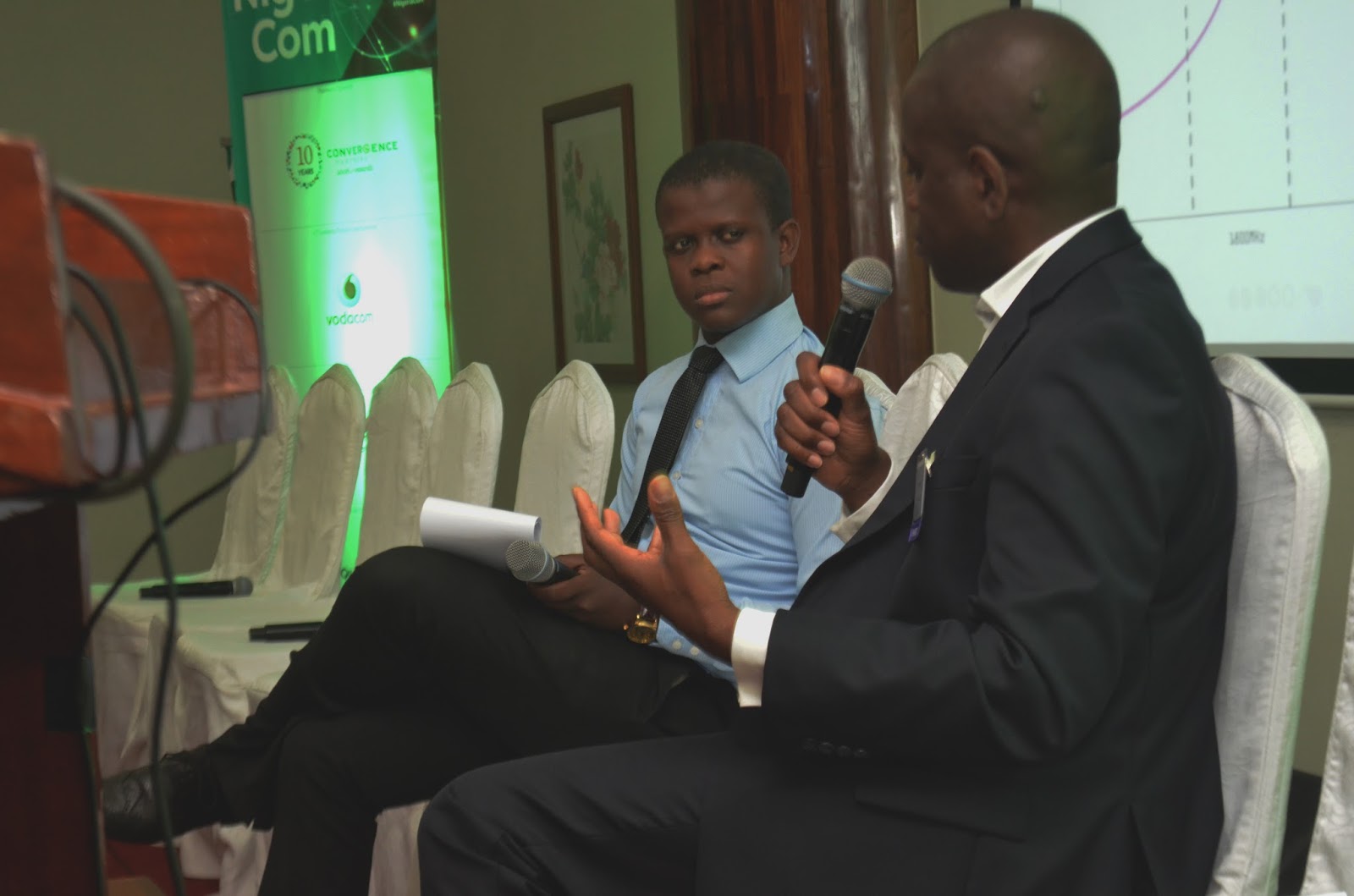
Kamar (right) presented: 'Being Broadband: This is How We Do It' at Nigeria Com 2016

Kamar who made the remark while speaking at the Nigeria Com 2016, said that despite the slow speed of data connections in the country, there is clear evidence that there is a hunger for reliable data connections in the country, noting that the industry is presently witnessing a fundamental and phenomenal shift from narrow band to broadband connection.

He said that to meet the of the needs of consumers for high speed broadband connections it has become necessary to embrace 4G technology, and that the migration to 4G broadband in the next five years will be greater than the migration to mobile communication.

He disclosed that the 92 million internet subscribers are connected through the narrow band connection and as such active subscribers have to contend with a 2G connection, which is lower than one megabyte connection per second.

He observed that as a result, the average consumption under the 2G connection is lower than 200 megabytes per month, compared to a global standard of 800 megabytes monthly, stressing that there is urgent need to address this deficit.


Paul Adepoju and Abass Kamar discussing Nigerian broadband potential

According to Kamar, the way out of the present trend of low speed data connections in Nigeria is 4G technology, if the industry must carter for the mass market needs, saying that the industry needs solutions that does not focus on cities but on the vast area of the country.

He said that the needs of the Nigerian internet community goes beyond city hotspots to mobile solutions that can carry a lot of capacity, noting that ntel has the ability to build Nigeria’s most constant efficient mass market mobile broadband network.

Kamar explained that although it went out to acquire a company that has been out of fashion and business, it has has the fundamental requirement of being built on what is called the 'golden spectrum'.

He added that ntel is built on the 4G/LTE, advanced technology is built on the 900/1800MHz spectrum, which can deliver the unbeatable and game changing customer experience of high speed internet access up to 230Mbps,"thus enabling a world of full mobile broadband experiences that will transform both lives and livelihoods.”

Abbas, an ex-Country Manager of Ericsson Nigeria, said that ntel is the biggest 4G network in the country today but that the decision of the company to rollout to only Abuja, Lagos and Port Harcourt was strategic, saying that beyond its inherited infrastructure - it also has secondary sites from tower companies.

In an address while declaring open the event, Portfolio Manager, Africa TMT KNects365, organisers of the event, Adam Thompson observed that Nigeria requires the diversification away from a heavy dependence on the oil and gas sector, and expansion of the knowledge economy.

He said that the development of ICTs marks a stronger prospect for social benefit and that this can only occur through convincing actions from the Nigeria Com participants.

This article originally appeared in ICT & Biz Africa

23 Sept 2016

NigeriaCom: Knowing what works as a Nigerian tech entrepreneur


By Olufemi Omotayo - Founder and Managing Editor, EntrepreNews

Nigerian technology entrepreneurs can create and grow viable businesses if they have more access to, and utilise, local resources.

The Oriental Hotel in Lagos recently played host to the 7th annual Nigeria Com, bringing together stakeholders in the telecoms and ICT sector to create discussion on deal flow around the nation’s digital future.

For two days, experts shared market insights on creating a better environment for tech SMEs and startups to develop; case studies of public private collaborations in m-Health; focused sessions on digital entertainment and matching content with the data gap.

For starters, did you know that the instant messaging market is currently witnessing another disruption besides WhatsApp?

CEO of Jongla, Riku Salminen, wowed the audience with statistics of how are capturing market share in Africa, using Nigeria as a key entry point.

Perhaps even more stunning is his announcement that Jongla has localised its offering to the Nigerian people, making it possible to communicate in the three major languages of Hausa, Igbo and Yoruba.


NigeriaCom plenary panel: Enhancing content integration to bridge the digital revenue gap – the rise of data driven services through smart devices

The key statistics from their survey so far reveal that news and information are top needs of Nigerians, followed by social networking.

Emeka Akano, the CEO of Jara Mobile corroborated this.

When asked about the kind of contents Nigerians love; he listed music videos, comedy, football, tech reviews, fashion, and gaming. But entrepreneurs must also find how to make these user-generated as it would accelerate their growth.

For Michael Ugwu, the GM West Africa of Sony Music, the question was whether Nigerians buy music? Surprisingly, he confirmed that their experience has been great since they launch last year and the Nigerian market is the fastest in Sub-Saharan Africa.

And, what is the secret of Goal.com? Daniel Price, Mobile Distribution Director, Perform Group says the secret is to keep innovating and changing things where necessary. He also advises that adding local flavour and voice is important.

Finally, he tells Nigerian entrepreneurs: “Don’t be afraid to fail.”


This report was originally published on EntrepreNews.

About the author:

Olufemi Omotayo is a social entrepreneur and multiple award-winning journalist/blogger with expertise in technology and entrepreneurship writing. He is the founder and managing editor of EntrepreNEWS, Nigeria’s foremost entrepreneurship medium. He is a seasoned speaker, mentor, facilitator and coordinator for many youth initiatives in Nigeria.

21 Sept 2016

AfricaCom touched down in Johannesburg

By Amy Turner - Com Series Staff Writer 

AfricaCom recently landed in Joburg for the launch of the bigger, better, bolder 2016 event.

The launch in Rosebank saw some of AfricaCom’s most prominent community members come together to discuss digital connectivity across the region, including a panel discussion themed: “Connecting Africa - Economic development and social empowerment through digital connectivity”.

The panel included: Luke McKend (MD at Google SA), Riaan Graham (Director of Sub-Saharan Africa at Ruckus Wireless) and Bora Varliyagci (Head of African Digital Infrastructure at Mott MacDonald), and was facilitated by Duncan McLeod, editor of TechCentral. The panel discussed some of the challenges hindering connectivity on the continent and the opportunities and innovations that are available in connecting the last mile.

Take a look at what went on and what's in store at this year's AfricaCom, taking place between the 14-18 November, at the Cape Town ICC:


AfricaCom is is the incubator for the architects of Africa'a digital future dealing with the core issues and opportunities of broadband and digital inclusion. 

Africa's biggest tech and telco event is taking place between the 14th - 18th November at the Cape Town ICC, find out more here.


You can book your AfricaCom tickets here.

Be part of the African tech and telco conversation, here:
AfricaCom
Youtube
Twitter
Facebook
LinkedIn
Instagram

16 Sept 2016

5 reasons Mark Zuckerberg's visit is good for the Nigerian ecosystem


By Chukwuemeka Fred Agbata Jnr - Founder of techsmart.ng

Nigeria is unfortunately always in the news for the wrong reasons. Yes, I know that we have some internal challenges but I am of the opinion that international press usually focuses on the bad stories about our country. That's why I believe that this trip by Mark Zuckerberg is good for the ecosystem, despite his capitalist sensibilities and commercial mindset - it is about value but the value must make economic sense.


With 17 million users, Nigeria is the Facebook's largest Sub-Saharan African market


Below are my thoughts on his visit:

  1. Let's look at some numbers. According to a report published by Tech Crunch; "Facebook has 120 million users in Africa, 84 million of whom are in Sub-Saharan Africa. With 17 million users, Nigeria is the company’s largest Sub-Saharan African market, followed by South Africa (14 million), and Kenya (5.7 million), according to spokesperson Aldous. A particular Africa play by Facebook will be tapping the online advertising market that’s rising with the continent’s shift to digital commerce. Africa’s online sales are expected to top $75 billion on by 2025, with $10 billion of it occurring in Nigeria."

    This report simply shows the potentials for any investor who wisely invests in the Nigerian economy. Yes, it is risky and unpredictable but then if you get it right you'll never regret it. This is something I believe Mark has realised and why he decided to visit.

    I was with of these young people when Mark walked into CCHub Yaba, he even spared time to listen to what these young folks are doing

  2.  The world would suddenly realise that Nigeria is no longer a state in a country called Africa, but the most economically viable market in Africa. Believe it or not, it takes a huge personality like Mark to pull this off and it is going to happen. Did you turn on CNN or BBC or international media in the last few days? If you did then you'd realise that Mr. Zuck visiting Nigeria and walking the streets of Yaba would likely make Silicon Valley realise that this market has great potential.

  3. His visit would for a long time to come serve as a gun powder of inspiration for enterprising youths and techies working day and night to make a difference in one of the world's most difficult operating environments. I was with of these young people when Mark walked into CCHub Yaba, to our amazement - he even spared time to listen to what these young folks are doing.

    I'd like to see more physical Facebook presence and investments because, the truth is, that this market is very important for the brand going into the future

  4. I believe government and policy makers should brace up and come up with policies that will encourage the ecosystem at large to develop. For example, the Nigerian Government has to explore ways to see that Facebook also contributes to this market by ensuring they pay taxes and invest more in the Nigerian economy. That is a tall order I know because you need a good infrastructure and relevant skills to be able to monitor all revenues coming from Nigeria.

    Another riddle I put before the government and other relevant bodies such as the Federal Ministry of Communications, federal lawmakers; Nigerian Communications Commission (NCC); National Information Technology Development Agency (NITDA) and others is simple; how would Facebook Free Basics operate in Nigeria? Are we going to have a national say in what happens or we are just going to stand and act like nothing is going on? How are we going to ensure that Net Neutrality is maintained? India took action so we must as least negotiate with Facebook as Mark has now clearly shown how important this market is to his companies.

  5. Mark and his team at Facebook should TRULY regard Nigeria as a key hub and priority partner. Therefore, I'd like to see more PHYSICAL Facebook presence and investments because, the truth is, that this market is very important for the brand going into the future.

About the author:
CFA is the founder of www.techsmart.ng and co-producer/presenter of Tech Trends on Channels Television. 


Be part of the African tech and telco conversation, here:


The Fourth Age: The socioeconomic benefits of NBN in East Africa - Nigel Bruin, Huawei

By Amy Turner - KNect354 Staff Writer 

"We need to include everyone and turn the rhetoric into action"

Africa has stepped into a new broadband era:

This year's East Africa Com Industry Keynote Address was delivered by Huawei's Principal Consultant, Nigel Bruin.

The focus of this Industry Keynote was to provide analysis of how broadband enables real socioeconomic development in Africa and how we can get there.

From leveraging infrastructure synergy to connect the last mile, Nigel explains how the National Broadband Network in East Africa can further grow and develop the region's economy and services.

This Keynote also served to lay out the 6 proven ways to develop NBN and the role governements can play in developing sound regulatory policies that can promote omnipresent and affordable broadband services.


If you are interested in how tech and telco is enabling socioeconomic development and social empowerment on the African continent, through the involvement of Huawei and others, why not attend AfricaCom 2016?

AfricaCom is is the incubator for the architects of Africa'a digital future dealing with the core issues and opportunities of broadband and digital inclusion.

Africa's biggest tech and telco event is taking place between the 14th - 18th November at the Cape Town ICC, find out more here.

You can book your AfricaCom tickets here.

Be part of the African tech and telco conversation, here:
AfricaCom
Youtube
Twitter
Facebook
LinkedIn
Instagram


13 Sept 2016

5 mistakes new African fintech entrepreneurs make


The African fintech space is growing fast, but there are a number of mistakes entrepreneurs make when entering the industry, according to Johan Meyer, founder and chief executive officer (CEO) of South African fintech company Wallettec.

As a fintech entrepreneur, I must say, there are times when our industry can be confusing but still exciting at the same time. There are too many fintech startups but are all promising “disruption”. In Africa, for example, we currently host over 200 fintech startups. It’s an explosive and promising industry and its bright future is undeniable. Our contribution in bringing in new and innovative ideas and inclusiveness cannot be underestimated.


According to KPMG, fintech investments hit an all time high reaching US$19.1 billion in 2015. It can come across as too crowded though, as some ideas seem recycled and irrelevant to the market. This has also given birth to countless conferences and seminars, which cost an arm and a leg to attend, let alone speak. We’re searching for that next big idea. Fintech is defining its space and we’re always asking, how can we make financial services better, cheaper, exciting and inclusive with no boundaries?

At Wallettec, for example, we partner with other fintech companies in seven countries. One thing we have in common with other fintech entrepreneurs we connect with throughout Africa and the world, is we believe financial technology has the power to truly empower people, not only by giving them the tools to trade but by also enabling them to expand their income by means of new services they can offer to the community access to financial services to protect their income and their families.

As someone who’s been operating in the fintech space for over a decade, I’ve observed a few challenges and mistakes new African entrepreneurs make when entering the industry. Below are five of them.


Solving African problems with a global person in mind


Our challenges should be solved with a local in mind. A massive percentage of Africa is underbanked and still using feature phones. Why do most fintech companies concentrate on disrupting the banking industry by developing digital banking apps for smartphones, if most of their market is still on feature phones? Out of the 550 million mobile phone subscribers in Africa, less than one-third owns a smartphone.


If it works in the UK or US, it will work in Africa


Most fintech companies copy what’s being done in America or Europe and try to bring it to Africa. Once again it’s a no! Africa is a very unique market and should be treated that way. The same applies in the USA and UK, they look at African countries such as Kenya and think products like M-Pesa would work – it fails almost all the time.


The financial inclusion theory


All fintech startups claim that they work on financial inclusion. True financial inclusion isn’t just payments only. It helps a street merchant gets access to income protection. It gives the elderly the ability to get funeral cover or claim social grants without travelling for hours just to stand in a queue and get their grant money.


DIY


Doing it yourself in fintech is like trying to win a war with one soldier, the market is massive. If fintech companies could start working together and develop a true solution that will unify different fintech industries, they’d all benefit. For instance, in South Africa, when banks formed the Payments Association of South Africa (PASA), they unified. There’s no way single fintech companies can disrupt the industry in Africa if they don’t work together.


Not doing research


Before developing a solution, find out what your market needs. The only way to develop a true workable solution is to know what the problem is. Most fintech startups develop solutions without an idea of what their market needs.


This post comes courtesy of Disrupt Africa:


This year's AfricaCom is home to the bigger, better, bolder AHUB powered by Ericcson.

The AHUB is the meeting place for Africa’s start-up community – and start-ups and investors go free. Register for your pass to the AHUB here.


If you are interested in how tech and telco is enabling socioeconomic development and social empowerment on the African continent, through start-ups initiatives, why not attend AfricaCom 2016?

Africa's biggest tech and telco event is taking place between the 14th - 18th November at the Cape Town ICC, find out more here.

You can book your AfricaCom tickets here.

Be part of the African tech and telco conversation, here:
AfricaCom
Youtube
Twitter
Facebook
LinkedIn
Instagram