10 Jun 2013

IPX to Stop the Many, Many, Many, Many Network Interconnect Chaos


Dialogic is exhibiting at Connecting West Africa, taking place at the Radisson Blu Hotel in Dakar, Senegal tomorrow and Wednesday 11th of June.

Jim Machi is the Vice President of Product Management at Dialogic. Today he shares his views on Network Interconnect Chaos.

A while back, I spoke at the US Telecom “Voice Innovation Summit”. I was placed in the part of the conference titled “From POTS to Communication Free-For-all”. My point of view is that even though yes, there are many, many, many, many, many, many, many, many different types of IP Networks, it really doesn’t have to be a free-for-all. First of all, connectivity is happening today, so it’s fine in a certain respect. But it can clearly get better, and if you are running a business and need to connect from one country to another, IPX is one such framework to stop the chaos.

This blog is not going to be a treatise on IPX and if you want to learn more about it, please read our whitepaper here.

What I spoke about is that because of different types of signaling on IP networks (because of SIP variants for instance) and because of different types of media for the IP networks (different voice and video codecs), and that fact that the IP networks still need to connect to the PSTN, you get into a need to translate all of these things when crossing network boundaries. This is no different than before, and why gateways exist. However, in the IP centric world, this is why Session Border Controllers exist.

But carriers don’t want to run their services over the public internet. There isn’t any control over the quality, nor the security. So the IPX framework deals with this. It’s essentially a very large private IP network. So if you are IPX enabled, then as you cross network boundaries the signaling and media conversion is taken care of, and the security as well. One can join and participate just as a pipe (called bilateral transport), or be service aware and charge for minutes for instance (called bilateral service transport) or be a multilateral service hub, which is where the QoS and this differentiated, premium services can live.

I then gave some examples of different networks and their needs when crossing boundaries, such as fixed networks to mobile networks (even if both are IP), etc.

If one thinks of the IPX as a big “cloud” then you can put IPX aware equipment in there that can accommodate transcoding, etc. I gave an example of a live press conference demo we did at the past CTIA – where we demonstrated mobile video conferencing on the Verizon network where we had a few people on the LTE network in New Orleans, one on the 3G network in Times Square, one on a WiFi network and one on a wired IP network, all with differing endpoints. It worked. But imagine if we had tried this from different countries! No way at this time. But if IPX was in place, it definitely could have worked.

So in summary, if you don’t know about IPX and want to learn more, go read something J But IPX is a mechanism that can provide for internetworking with IP and legacy networks, can be a platform for enabling value added offerings that enhance the user experience, and can be a common platform for cost efficient optimal global routing of IP traffic. A way to end pending chaos.

Find out more; meet Dialogic at Connecting West Africa, visit Stand 15. Visit the website: www.comworldseries.com/westafrica

7 Jun 2013

Jim Machi, Dialogic on software based session border controllers

Dialogic is exhibiting at Connecting West Africa, taking place at the Radisson Blu Hotel in Dakar, Senegal on Tuesday the 11th of June.

Jim Machi is the Vice President of Product Management at Dialogic. Today he shares his views on software based session border controllers.

Why would you want a software based session border controller?   

Why would you ever want a software-based session border controller (SBC)?  Is it even feasible? Right now, SBC’s are boxes that often implemented at the edges of IP-based networks.  It might seem unlikely for a hardware node of that critical network element morph to become a piece of software.

If the SBC sits on the border of two IP networks, then there are IP connections on both sides of the box, while means there is a physical connection to an IP network.  However, that physical connection doesn’t have to be at the exact demarcation point.  In fact, it doesn’t have to be part of the SBC box. Some other device could take care of the physical IP connection, and the IP data stream could then pass through a software-based SBC function that resides elsewhere. For example, a software-based SBC could be a resident in a commercial off-the-shelf (COTS) type chassis, such as an ATCA chassis, where network interface cards (NIC) handle the connection to the IP network. A series of single board computers could go into the chassis where the software based elements could run as an application. The software-based SBC could simply be connected and running on one of the single board computers. It could be running in a virtualized environment in a single board computer, or as part of a few applications in a 1U or 2U platform. Ultimately, it could also be in a cloud environment.  In this case, the actual physical NIC could be thousands of miles away from the SBC software.


Now that we’ve deemed it feasible, why would someone want to use a software-based SBC? First of all, economics come into play. COTS hardware can enter the picture, and when that happens, costs for that product set typically come down. A related piece to this reasoning is savings on the chassis. If you put the SBC on a single board computer that goes into a common chassis with multiple other network notes, also on single board computers, then there is savings on the chassis.   There would also clearly be sparing savings, since the COTS components are less expensive, and they would be more commonly available, obviating the need to as much on-site sparing. 

Software based SBCs are also a great way to get started if you think you need one. If you don’t know how many sessions you need, then you can get started using this and scale it up relatively easily. And it may be more economically viable for your situation if you need to scale as you go. 

Additionally, you can add more resources to the SBC easily. At Dialogic, we believe strongly that media and multimedia transcoding will be required for the SBC, and not because that is a strength of ours. We believe in that because if you buy into the notion that an SBC is basically an IP-IP gateway, then it will be obvious that transcoding would be required since transcoding is required in a TDM-IP gateway.  It’s simple if you think about it from that perspective. 

Let’s get more specific now. From a service provider perspective, costs and CAPEX are clearly important and we covered some of that above from the perspective of using COTS hardware. However, another consideration of using COTS hardware is some hardware (the base chassis say) will go away as part of using a software-based network node, and then CAPEX will go down. This is clearly a driver as well for a movement to software based elements. 

Another important consideration though is that service velocity is increasing. New services are being rolled out quicker. Agility with respect to the network elements are required to be able to meet these needs. Software-based network elements enable this agility because of what I said above – ease of scalability and ease of adding newer functions such as transcoding.  It’s likely that the needs of the SBC will continue to evolve over time. With transcoding right now, we see the needs to transcode HD Voice codecs to the more “regular” codecs. But in the future I’m sure we’ll see video transcoding needed as well. Even if you feel video transcoding is covered now, what about when the H.265 video codec comes out in a year? Will you need to buy a new SBC to cover that?  Or can you upgrade a piece of software?

And what about when WebRTC enters the scene? There is transcoding required there as well because the WebRTC audio and video codecs are different than utilized in the networks today. But there is also a signaling conversion required as the HTTP to SIP signaling conversion needs to occur. Having a piece of software to upgrade would also enable this support much easier. Transcoding and WebRTC are just two ideas that come to mind right now. What is the future to hold in this regard? Yes, you know that there will be a lot more!

For enterprises, software-based SBCs offer many of the same benefits as above, especially as it relates to WebRTC since I would expect WebRTC to enter the enterprise first. Integration of enterprise apps, whether WebRTC apps or not, could be a big differentiator with a software based SBC. And a software-based SBC, with its ability to scale down, offers a cost effective alternative for enterprises that don’t have one today, because the SBCs on the market are either too expensive for them or because the ones on the market today offer “too much” in terms of session capability. 

So you can see why a software-based SBC is convenient. But can it do what the hardware based SBC’s can do? Obviously, that is dependent on your supplier, but there is no reason that the software based and hardware based SBC cannot handle the same functions. There might be hardware assist in a hardware based SBC, but this would be to enable higher densities or more sessions, but shouldn’t be there to add features. At Dialogic, this is what we believe anyway. Almost 13 years ago Dialogic really drove the concept of Host Media Processing as an alternative to the Computer Telephony Integration (CTI) boards that drove Dialogic’s early years.  We know what is possible as the technology transitions to software.  And we know that you don’t have to lose functionality in this transition. We are experts in this “software-ization” of hardware and have applied this mantra to our software based SBC.

Software based SBCs have entered the industry discussion, because there are use cases where they make sense. If you are considering using one, or want to talk more about this, let us know.
Find out more; meet Dialogic at Connecting West Africa, visit Stand 15. Visit the website: www.comworldseries.com/westafrica

5 Jun 2013

Jim Machi, Dialogic on The Promise of the African VAS Market


Dialogic is exhibiting at Connecting West Africa, taking place at the Radisson Blu Hotel in Dakar, Senegal on Tuesday the 11th of June.

Jim Machi is the Vice President of Product Management at Dialogic. Today he shares his views on the Promise of the African VAS Market.

I was asked a question a few weeks ago about “the future” of value-added services in Africa. This question was deeper than it first appeared because the person asking me the question was really wondering whether VAS will be “required” once 3G services, and thus over the top services (OTT), become bigger over time in Africa. Before we really get down to answering the question, it’s important to remember that a value-added service is a service beyond voice that the consumer is willing to pay for. This does not necessarily mean that it has something to do with mobile broadband and smartphones. In fact, the advent of value-added services (and innovative value-added services at that) occurred with basic feature phones long before mobile broadband was even feasible. SMS, and derivatives of SMS such as voice SMS, televoting using SMS, gaming using SMS, and color ring-back tones are examples of value-added services that have generated revenue for service providers because they provide value to the subscribers.

So yes, VAS has a very bright future in Africa. According to the June 2012 Wireless Intelligence report, “Global Cellular Market Trends and Insight,” Africa has an almost 17% annual mobile connection growth rate, which is the world’s fastest growing, and 3G accounts for more than 10% of all connections in Africa. This shows the great potential for all kinds of value-added services.

And right now, Dialogic customers offer a wide range of VAS that are applicable to and being sold in Africa today, ranging from text messaging (including voice SMS), mobile payments (including exchanging pre-paid from one phone to another phone), IVRs and roaming solutions. Please see the Dialogic Solution Showcase on our website for examples of deployed services. We will see more VAS going forward, and we should get a glimpse of some of these new services at Connecting West Africa in June.

So, back to the reason behind the original question I was asked. What a value-added service is will change as networks change and as subscriber demand changes. However, the key principles of value-added services will remain, which is why VAS will always be a key ingredient to a service provider offering even as the networks change:
  • Use VAS as alternative to voice communication mechanisms, such as texting. As smartphones and mobile broadband enter the market, this will likely morph to include other communication mechanisms, such as those provided by instant messaging or Facebook.
  • Use VAS as a personalization vehicle, such as with color ring back tones or social networking interaction.
  • Use VAS as entertainment, such as with televoting for TV shows or playing games. Again as mobile broadband enters the market, we will see people using their phones to watch TV or videos on YouTube as an example.
  • Use VAS as a way to improve your productivity, such as with location-based services or IVRs.
  • Use VAS for mobile commerce, such as with payments or mobile banking. As mobile broadband becomes more prevalent, and people start using their smartphones as an on-ramp to the internet, you will likely also see more mobile advertising (think about going to the internet today and how common it is to see advertisements). 

Find out more; meet Dialogic at Connecting West Africa, visit Stand 15. Visit the website: www.comworldseries.com/westafrica

4 Jun 2013

Jim Machi, Dialogic on Mobile Congestion, Radio Blogging and Podcasting


Dialogic is exhibiting at Connecting West Africa, taking place at the Radisson Blu Hotel in Dakar, Senegal on Tuesday the 11th of June.

Jim Machi is the Vice President of Product Management at Dialogic. Today he shares his views on Mobile Congestion, Radio Blogging and Podcasting.

Over a month ago, I participated in a radio blog / podcast ]
with Tech in Twenty. The theme was mobile congestion. Please listen to the 20 minute broadcast/podcast/radio interview since it was riveting! Seriously, it was fun, the interviewers Luis and Jennifer asked good questions and I think the interview is interesting. But then again, that’s me J.

Let me briefly go over what I covered in that podcast. Mobile congestion is something we’ve all experienced likely multiple times and it is best exemplified by the “spinning” icon you get on your phone when you’re trying to access a video. Everything just slows down. I think we can all understand that. And with more tablets, more smartphones, more smart mobile whatever’s, this problem is just going to continue to get worse.

The interviewers then asked me, OK, why don’t the carriers just build more towers? Well, they could and in fact do, but in reality there are many reasons for the “spinning” so there are multiple ways to attack the problem. First of all, the carriers can ask the subscribers to pay more when they are using the network as an on-ramp to the internet ALL THE TIME. So that’s why you see many carriers having data capping pricing plans. The carriers can also buy or build additional capacity such as adding cell towers are leasing more transmission lines. New technology like advanced codecs comes into play. Upgrading networks such as going to LTE, or advanced versions of 3G, also come into play. Also, instead of using the mobile cellular network you can use Wi-Fi as an offload mechanism. And finally, one can maximize the existing capacity of the network by optimizing the traffic that flows through it.

All of these are part of the solution and they were wondering how Dialogic played in the space and why we were unique. Great question. We play in the space by offering solutions that maximize existing capacity through optimizing the traffic. This is a very cost effective and fast way to add more capacity to the networks, which is why carriers would come to us. And we are unique since have capability and expertise in BOTH voice and video, not just voice, or not just video.

We covered a lot of other ground as well, so go listen. I had a good time with it.

Find out more; meet Dialogic at Connecting West Africa, visit Stand 15. Visit the website: www.comworldseries.com/westafrica


22 May 2013

East Africa Com: See you next year | 20-21 May 2014


*** Share your thoughts on #EastAfricaCom @allaboutcom ***    

East Africa Com 2013 Day 2: Affordable & relevant services are needed to drive growth in East Africa’s telecoms market!

After a first day where networks were at the centre of most discussions, the second day of East Africa Com looked in more details at services.

The day started with an interview of Jose Henriques, VP data and online at Airtel Africa, who highlighted the importance of affordability of data services, both in terms of data pricing and of devices. He was followed by John Naranka, who gave the point of view of an OTT player: Kenya-based social network Whive. 

The sessions covered the services that are most likely to impact data growth in the region: content, mobile money, e-health, TV, mobile marketing and apps. Some keywords were repeatedly mentioned when discussing how to make services successful: affordability, user-friendliness and simplicity. Betty Mwangi-Thuo from Safaricom (who gave an update on the ever successful mpesa) also highlighted the importance of partnerships to ensure the success of services.


The topic of e-health was covered by a presentation from a representative of Ogra Foundation, the event’s charity partner, which works with and for vulnerable communities in Kenya to improve and promote health. 

The event ended with the AppGig, a new session dedicated to developing, promoting and monetising apps for East Africa. A lively panel discussion covered both technical and commercial issues. The audience had a chance to share their favourite apps for the region, ranging from traffic news to education and health.


East Africa Com was once again a great showcase for the innovation and entrepreneurship to be found in the region. Next year’s event (to take place in Nairobi on 20-21 May 2014) will again focus on how to make networks more reliable and affordable in order to provide relevant services for the region’s users. 

Until then, the next events in the Com World Series will look at networks and infrastructure developments in West Africa (Connecting West Africa, 11-12 June, Senegal), Digital services (Digital Services Africa, 25-26 June, South Africa) and trends in Africa’s largest digital market (NigeriaCom, 17-18 September).

We look forward to seeing you next year at East Africa Com 2014.  
  
--------------------------------------------------
Thanks for tweeting and using the hash tag #EastAfricaCom @allaboutcom 
--------------------------------------------------


The East Africa Com team received a record breaking 500+ tweets over the course of the two days, which surpassed last year’s tweet record by 68%. Plus, the hash tag #EastAfricaCom was trending on Twitter today as a key topic in Kenya.  

We look forward to reading your tweets next year! 

You can still tweet about your experience this year using #EastAfricaCom @allaboutcom on twitter!  

--------------------------------------------------  
What our attendees said about this year's show:   
-------------------------------------------------- 

“Overall conference was well organised, excellent networking and good contacts with my operator customers in the region with some hot leads generated”
Regional Account Director, SAP UK Limited

“Well organised event & excellent contacts made. Speed Networking sessions were great! Propose that you keep doing them again!”
Regional Director – Africa, iBasis

“We had very good two day at East Africa Com and made valuable contacts during networking with new & exciting partners”
VP Sales, Ekinops France

“Great event! It is our first time at East Africa Com and it was a good opportunity to interact with more players in the region as well as our clients. The speed networking was a valuable session in which we got to sell ourselves to potential clients”
Commercial Officer, ComzAfrica Kenya

“Informa put on a great networking event presenting valuable opportunities to explore business relationships.” 
Cyrus Sang, Executive Director, Jamii Telecom Ltd, Kenya

“Good show and productive targeted meetings with East-African operators – will definitely take part again.”
Philippe Llau, Director Line of Business Data & Telecom, Eutelsat France

“It has been a pleasure attending East Africa Com and participating as a panellist, hearing and sharing views from other regional players.”
Betty Mwangi-Thuo, General Manager, Financial Services, Safaricom

------------------------
Thank you to all the Sponsors of East Africa Com 2013
------------------------  
  
Comza * Eutelsat * Liquid Telecom * KDN * Simbanet
  
------------------     
See You Next Year!     
------------------     
To get involved early for the 2014 show,       
please visit our website: http://eaafrica.comworldseries.com/


 East Africa Com 2014 
20-21 May 2014 
Safari Park Hotel
Nairobi, Kenya 


21 May 2013

"East Africa is all about innovation, change and growth” – East Africa Com opens in Nairobi

***Join us for day 2 ***  Share your thoughts on #EastAfricaCom @allaboutcom 

The 9th annual East Africa Com opened in Nairobi today with great debates showcasing the dynamism of the region’s market. Senior executives from the telecoms, media and ICT sector from the whole region were in attendance to define strategies for a changing market as well as to network with their peers and to do business.  
  
The keynote session offered a great overview of the key trends, challenges and opportunities facing stakeholders in the digital market. A debate on the evolution of the ecosystem saw Michael Ghossein, CEO of Orange Kenya and Joseph Mucheru, Sub-Saharan Africa Ambassador at Google lock horns on the subject of partnerships and revenue sharing between operators and OTT players. 
  
Richard Bell, CEO of triple player Wananchi showcased the diversity of the opportunities in the new digital ecosystem. He summed up the enthusiasm of many in the audience by saying: “The reason we’re all here at this event and the reason why East Africa is so exciting is because East Africa is all about innovation, change and growth”. 
  
The other main subject of the day was broadband and connectivity, whether from mobile or fibre/satellite developments. The sessions included contributions from MTN Business Kenya, Airtel, Canar Telecom Sudan, PCCW/Gateway, Eutelsat and more. The conference in the afternoon broke into two sessions, one looking further into connectivity themes and another one looking at Customer Experience Management with in particular a presentation from Safaricom. 

Meanwhile the adjacent exhibition was all about networking and business meetings. Over 25 exhibitors showcased their products and solutions for the market. A Speed Networking session took place during the morning coffee break, bringing together 20+ VIP guests from the region’s leading operators to meet solutions providers and vendors. The day ended with a poolside networking drinks reception sponsored by Liquid Telecom – a great place to unwind after a busy day! 


“It is clear from the debates both in the conference and in the networking breaks that the East Africa region is a great hub for business in Africa” says Julie Rey, Research Director at organisers Informa Telecoms & Media; “We are proud to organise East Africa Com as the region’s annual forum to encourage debate and business deals in this dynamic environment”. 

The second day of East Africa Com will include sessions on data strategies, digital services, mobile money, mobile marketing and the AppGig for developers.  
  
------------------------------ 
Make sure to join us for Day 2 
------------------------------ 
    
There is an outstanding speaker line-up for day 2 of the event as well -   
make sure to join us tomorrow!   
  
---------------------------  
Timings:   
---------------------------  
  
Registration Day 2:  08:30am    
Conference Day 2: 09:00am - 15:30pm   
    
APPGIG at East Africa Com  
Conference Day 2: 14:00am - 15:10pm  
    
-------------------------------------------------- 
What are your thoughts on this year's East Africa Com?   
-------------------------------------------------- 
  
The East Africa Com team received a record breaking 300+ tweets within the first 4 hours of the conference, which surpassed last year’s tweet record by 50%. Plus, the hash tag #EastAfricaCom was trending on Twitter today as a key topic in Kenya.  
  
So don't forget to tweet about your experience using #EastAfricaCom 
@allaboutcom on twitter!   
  
--------------------------------------------------   
Feedback about Day 1 on Twitter:      
--------------------------------------------------  
"People are discussing major business deals at #EastAfricaCom" 
Robert Alai, Blogger, Techmtaa 
  
------------------------ 
Sponsors of East Africa Com 
------------------------   
    
Comza 
Eutelsat 
Liquid Telecom 
KDN 
Simbanet 
    
Join us tomorrow at the Safari Park, Hotel in Nairobi, Kenya!
The East Africa Com Team  
  

27 Mar 2013

See you next year at EurasiaCom | 25-26 March 2014

*** Share your thoughts on #EurasiaCom @allaboutcom ***     

 EurasiaCom 2013: it's all about the customer in Eurasia's changing digital market
  
------------------------------------------------------------------------After two days of engaging discussions and networking, the 9th annual EurasiaCom conference and exhibition closed today in Istanbul. 


The conference included presentations and panel discussions with over 40 senior representatives of the region's most dynamic telecommunications and digital service providers: operators (Vimpalcom, Turkcell, TeliaSonera, MTS, Megafon, Azerfon, Virgin Mobile, Bakcel and more), OTT providers (Google, Mynet), regulators (Bulgaria, Bosnia Herzegovnia), handset specialists (Yota Devices, KVK), app developers (Fugo, Baba Girisim) and more. 


 The overall message of the debates was that telecom operators need to change their business models to adapt to a new digital environment where customers have different requirements. Telcos are still concerned about the threat posed by OTT players to their revenues but they are now open to partnering with them in order to answer their customers' needs.  


New revenue opportunities are emerging that will hopefully compensate the lack of revenues from data. However the companies who will be most successful will be those who understand their customers best and can move rapidly to meet their needs. 


  The EurasiaCom programme included new sessions in addition to the traditional keynotes on strategic business and network issues, which reflected the new important topics in the digital market: customer experience management, handset and devices, M2M, applications.


We look forward to seeing you next year at EurasiaCom 2014.     

       
--------------------------------------------------
What are your thoughts on this year's EurasiaCom?   
--------------------------------------------------
       
Tweet about your experience using #EurasiaCom @allaboutcom on twitter!

--------------------------------------------------
What our attendees said about this year's show:      
--------------------------------------------------
   
"It was an excellent event with a lot of speakers and useful content. I think it is one of the top Informa conferences. If you want to participate in some of Informa's conferences, absolutely put Eurasia Com in your preference list."
M. Hossein Taheri, Senior Analyst, Teyf, Iran

“Two amazing days to meet top class decision making operators from Europe and Asia”.
Sorin Balasoiu, Account Director, Ascom, Romania

“Eurasia Com has been a great opportunity to meet and network with mobile network operators and other organisations in the telecom industry from different countries in the region such as Turkey obviously, Russia, Albania, Kazakhstan, Ukraine, Yemen, Bangladesh, Iran etc. Looking forward to generating some business growth from these leads.”
Ivy Mumo, ComzAfrica, Business Development, Kenya

“Excellent organisation and high quality of delegates. Very timely and interesting discussion themes, engaging speakers and panellists, true representation of the Eurasian region.”
Jaques Couvaz, Senior Lecturer, Billent University, Turkey

“I can easily say that the whole event was very useful for me to get in contact with the right people and companies.”
Erkan Keskin, Data Account Manager, Turkcell Superonline, Turkey.

“Nice presentations, special perspectives shared on Customer Experience Management. Eurasia Com brings lots of discussions and ideas. Looking forward to join next year.”
Nevila Bejleri, Customer Experience department Manager, Albtelecom and Eagle Mobile, Albania

“Good event, lots of live presentations and cases. Would be glad to do this again!"
Sergey Radchenko, Development Division Director, Megafon, Russia

------------------------
Thank you to all the Sponsors of EurasiaCom 2013
------------------------  
     
Comza * Mahindra Comviva * CommScope * Cambium Networks * Intersec * Vidiator

------------------  
See You Next Year!  
------------------  
To get involved early for the 2014 show,    
please visit our website: www.comworldseries.com/eurasia
 
EurasiaCom 2014
25-26 March 2014
Swissôtel The Bosphorus,
Istanbul, Turkey 

26 Mar 2013

The 9th annual EurasiaCom opened today in Istanbul...


***Join us for Day 2!***    Share your thoughts on #EurasiaCom @allaboutcom  

----------------------------------------------------------------------------------------------------

The 9th annual EurasiaCom conference and exhibition opened today in Istanbul, providing key debate and networking opportunities for the region’s leading operators and digital companies.


The first conference day focused on the evolution of the market and how telecom companies adapt to new conditions: networks need modernising to meet increased demand for data; operators are building partnerships with OTT players; new pricing models need to be developed; operators must understand their customers better; new revenue opportunities must be explored (e.g. mobile financial services, M2M, cloud), etc.


Some of the region’s leading operators were sharing their expertise and vision of the market evolution. Dmitry Kromsky, Head of Vimpelcom’s CIS business unit, said: “I am happy to have the opportunity to participate in this forum; the potential of all countries in this region is very high”. Rob Shardlow, Group Sales & Business Development Director at Virgin Mobile CEE said he was “incredibly pleased to be here today: there are fantastic characteristics to the market and the region offers great opportunities”.


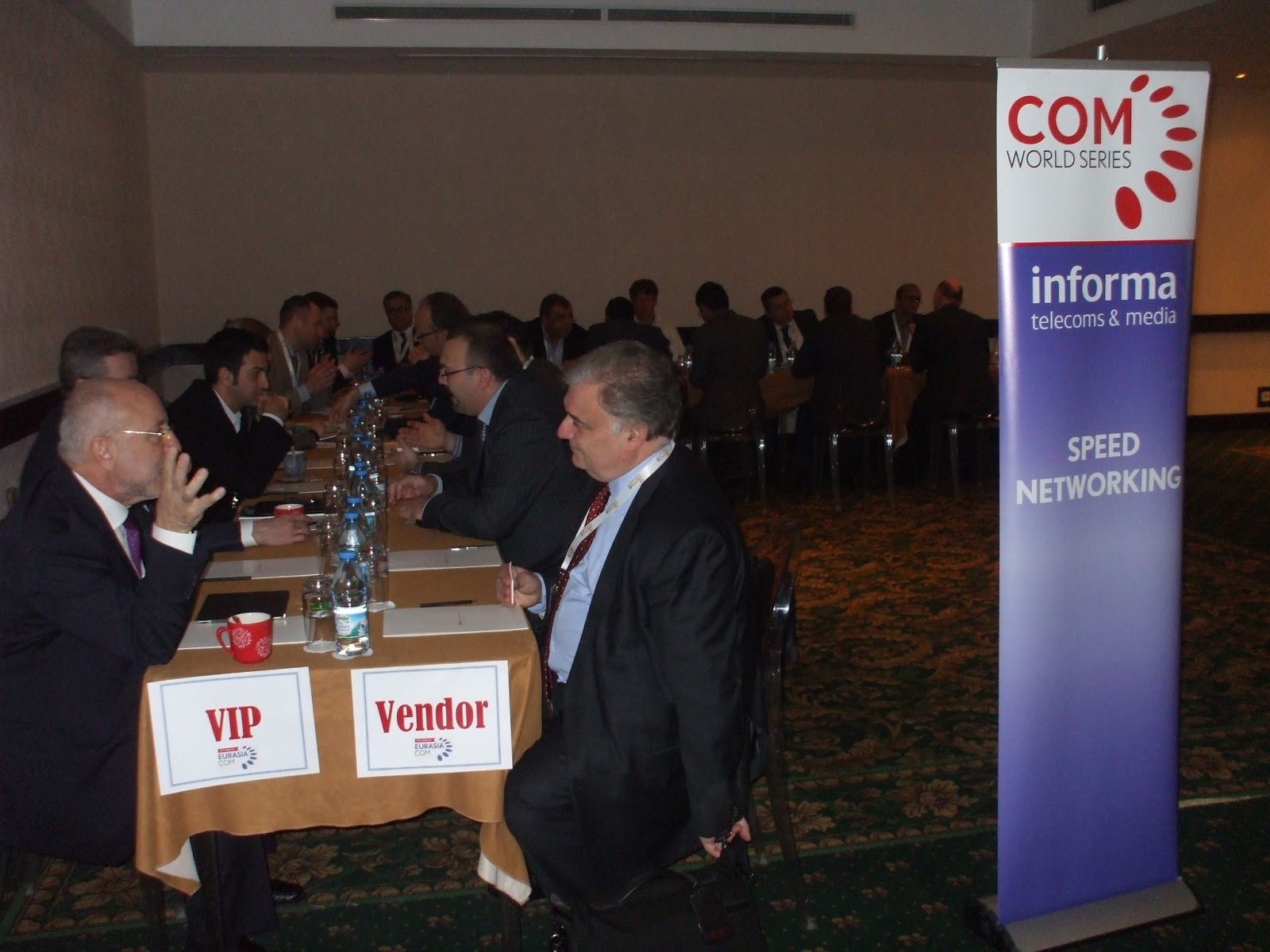
In addition to the conference the event is an occasion to network with the region’s telcos, regulators and digital companies. The morning break included a Speed Networking session for vendors to meet with some of the event’s VIP participants.


“The debates at EurasiaCom are always engaging and we are pleased to see the region’s most innovative companies share their ideas in a very open way” says Julie Rey, Research Director at organisers Informa Telecoms & Media.


Tomorrow’s session will focus on innovation and digital services (including two new sessions on M2M and apps), with speakers from Turkcell, Google, Mynet, Yota Devices, Vimpelcom, Deutsche Telekom, Megafon and more.


We look forward to seeing you at the second day of EurasiaCom. 
 
------------------------------
Make sure to join us for Day 2 
------------------------------
       
There is an outstanding speaker line-up for day 2 of the event as well -    
make sure to join us tomorrow!    
       
--------------------------------------------------
What are your thoughts on this year's EurasiaCom?    
--------------------------------------------------
       
Tweet about your experience using #EurasiaCom @allaboutcom on twitter!

--------------------------------------------------
What our attendees said about Day 1:    
--------------------------------------------------
   
“EurasiaCom is a unique conference that brings together operators, regulators, vendors, content and application developers and addresses topics catered to all members of the ecosystem around the telco industry”
Sergey Nichiporuk, Head of Strategy, MTS Ukraine

“Again, this year’s event has been a great success in creating new business opportunities.  Speed networking is the right way to start the event”
Thomas Sachs, Senior Account Manager, CreaLog

“Many thanks to the organisers of the conference; it was all “high”.  Also, thanks to all the speakers, learnt a lot and met many interesting people.  I hope we will meet again and cooperate”
Bakyt Kaiykov, Head of Department of the Transmission Network, MegaCom, Kyrgystan

“Speed networking was very useful to meet other participants.  The Informa team is very proactive with introductions.”
Shishodia Upkar, Manager – Europe, Mahindra Comviva

------------------------
Sponsors of EurasiaCom 
------------------------  
     
Comza * Mahindra Comviva * CommScope * Cambium Networks * Intersec * Vidiator

20 Mar 2013

Announcing the programme for Connecting West Africa, 11-12 June, Senegal

What is needed to deliver reliable and affordable communications to West Africa?

Connecting West Africa is the place to find out about networks and infrastructure developments in Africa’s most promising region. Over two days (11-12 June in Dakar, Senegal), the conference and exhibition will offer in-depth discussions on and networking opportunities with the region’s leading minds.

The brochure with full details on the programme and how to participate is available here.

Connecting West Africa is the new brand for the Com World Series’ event in the region (formerly West & Central Africa Com), looking specifically at the networks and infrastructure developments. Over two days, the conference will address the major concerns in terms of connectivity in West Africa and help key stakeholders plan for the future: fibre and satellite development, cost of bandwidth, new needs from consumers and enterprises, partnerships, cost-efficiency, investment, rural telecoms and more..

Leading speakers include senior representatives of Orange, ExpressoTelecom , Google, Sonatel, Intelsat, Sierratel, Starcomms, O3B Networks, Tigo, Telecom Italia Sparkle, Helios Towers Africa, ECOWAS and more.

Plan your visit now and prepare to network with the decision makers in the region’s communications landscape.

If you have any question or if you’d like to participate contact:
- For programme enquiries and speaking opportunities: Julie Rey, Julie.rey@informa.com
- For sponsorship and exhibition enquiries: lee.dendy-sadler@informa.com
- For marketing and PR opportunities: Subuola.alinkugbe@informa.com
- For VIP and free passes for operators and regulators (limited availability): sofia.marti@informa.com


7 Mar 2013

Cambium Networks joins EurasiaCom as sponsor alongside ComZA, Comviva, Intersec and Vidiator

Wireless broadband and microwave solutions  provider Cambium Networks confirmed their participation as sponsor to EurasiaCom, taking place in Istanbul on 26th ad 27th March.

They will be represented in the conference by Ian Bayly, VP Sales & Marketing for EMEA, who will join the expert roundtable on meeting broadband needs across the region and will give a presentation. Cambium Networks joins other sponsors ComZA, Mahindra Comviva, Intersec and Vidiator.

EurasiaCom is the leading event for the telecoms, media and ICT sector in the region - comprising Eastern Europe, Russia, the CIS and Turkey. Top operators and digital brands will be represented onthe conference programme, including Vimpelcom. Altimo, Turk Telekom, Virgin Mobile CEETurkcell, TeliaSonera, Google, MTS, Yota Devices, Megacom and more.

For more information on the programme and how to participate click here.